
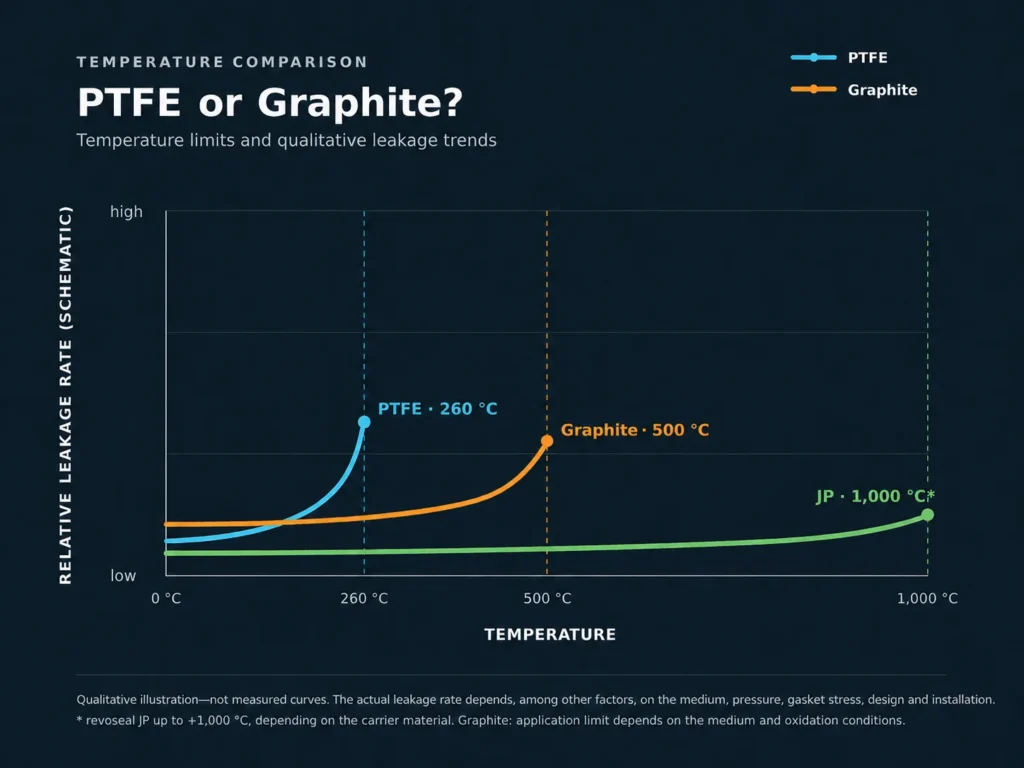
260 °C, 500 °C or even 1,000 °C? Temperature may seem to provide a clear answer when selecting a gasket. In practice, however, it is only one part of the decision.
PTFE offers excellent resistance to many chemicals. Graphite withstands significantly higher temperatures and adapts well to irregularities in the flange surface. However, both materials have their limitations.
Understanding Temperature Limits
Depending on the design, PTFE flat gaskets can be used at temperatures of up to approximately +260 °C. However, creep and relaxation increase as temperatures rise. This can reduce gasket stress, particularly under high mechanical loads or frequent temperature cycles.
Graphite is commonly used in industrial applications at temperatures of up to approximately +500 °C. It is compressible, temperature-resistant and able to compensate for minor surface irregularities. As a soft material, however, it must be protected against damage. The medium, pressure and oxygen content also affect its actual temperature limit.
Temperature alone therefore does not determine whether a flange connection will remain reliably leak-tight.
Temperature Cycles Affect Sealing Performance
During heating and cooling, flanges, bolts and gasket materials expand and contract at different rates. This changes the gasket stress within the connection.
Possible consequences include:
- creep or relaxation of the gasket material
- decreasing or uneven gasket stress
- damage to or displacement of the soft material
- increasing leakage rates
- recurring leakage
The decisive factor is therefore not only which material is used, but also how it is supported, protected and compressed.
The Revoseal Solution: JG/JP
The revoseal JG/JP combines a robust metallic carrier with an application-specific graphite or PTFE facing. Its raised inner and outer teeth encapsulate the soft material, limit its deformation and ensure controlled compression. At the same time, they create an additional metallic seal.
Depending on the carrier material and design, the JG/JP system is suitable for temperatures ranging from −270 °C to +1,000 °C and pressures from vacuum up to 400 bar.
The solution is therefore not simply graphite or PTFE. What matters is a gasket design that precisely matches the material, metallic carrier and geometry to the actual operating conditions.